Table of Contents
- What AI Development Services Actually Cover in 2026
- The four-layer stack (LLM, RAG, Agents, LLMOps)
- How the layers work together in a real product
- What's not an AI development service
- What Does an AI Development Services Engagement Look Like?
- How Do You Evaluate an AI Development Services Vendor?
- Production-grade track record (not demos)
- Data engineering and LLMOps depth
- Governance and compliance posture
- Post-launch ownership
- How Much Do AI Development Services Cost in 2026?
- PoC budgets ($15K–$150K)
- Production builds ($80K–$400K+)
- Hidden costs (the ones that surprise people)
- Pricing models
- Red Flags When Hiring an AI Development Services Partner
- "We'll fine-tune a custom LLM for you"
- No evaluation harness in the proposal
- Single-model lock-in
- No data-handling policy in writing
- Wrapping up
Share on social media


AI Development Services in 2026: What They Actually Include
"AI development services" used to mean: hire someone to fine-tune a model. In 2026, it means something much larger — and most RFPs we see still describe the work like it's 2022.
Here's the gap. 72% of enterprises now run AI in production, up from 20% in 2020. The average enterprise runs 4.2 AI models in production, more than double the 2023 number. Yet the typical brief still asks for "an AI feature" — singular, one model, one endpoint — when the actual scope is a system: an LLM (or several, routed), a retrieval layer connecting your private data, an agent orchestrating multi-step work, and the LLMOps glue that keeps all of it from silently degrading after launch.
If you're about to hire an AI development services partner, this is the brief you actually need to write. We'll cover what's included in 2026, how to evaluate vendors, what to budget, and the red flags worth walking away from.
What AI Development Services Actually Cover in 2026
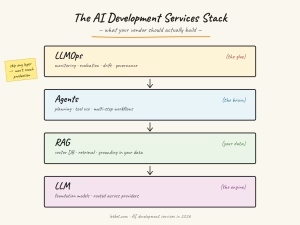
The four-layer stack (LLM, RAG, Agents, LLMOps)
A complete engagement in 2026 spans four layers. Skip any of them and the system either won't reach production or won't stay there.
LLM layer. The model that generates output — sometimes a foundation model accessed through an API, sometimes a fine-tuned variant for your domain. By recent enterprise survey data, 76% of companies running LLMs in production mix open-source with proprietary, often routed by task. A vendor that only knows OpenAI is a vendor with one tool.
RAG layer. This connects the model to your data. Vector database adoption grew 377% year-over-year for a reason — generic LLMs don't know your contracts, your support history, or your product catalog. RAG is how the model gets context without you fine-tuning on every document you own. Google's primer on retrieval-augmented generation covers the architecture in one page if you want the canonical reference.
Agent layer. Agents turn one-shot Q&A into multi-step work. By Arcade's 2026 State of AI Agents report, 80% of enterprise apps shipped in Q1 2026 embed at least one agent. The interesting work has moved here — tool use, planning, evaluation, human-in-the-loop checkpoints. We've written separately about production-ready LLMOps and agent patterns if you want a deeper dive.
LLMOps layer. The glue. MLflow defines LLMOps as the discipline of deploying, monitoring, evaluating, and governing language models in production. Without it, your AI feature ships hot and decays quietly. With it, you catch regressions before users do.
How the layers work together in a real product
Take a customer-support copilot. A user asks a question. An agent reads it, decides retrieval is needed, calls the RAG pipeline against your knowledge base. The LLM generates an answer grounded in the retrieved chunks. The LLMOps layer logs the trace, evaluates response quality against a held-out test set, and pages someone if the eval score drops.
Four layers, one feature. That's the modern shape. If your vendor's proposal only describes layer one or two, you're being scoped for 2022's problem.
What's not an AI development service
Worth being explicit, because the line gets blurred. Calling the OpenAI API from your app isn't an AI development service — it's API integration. Subscribing to an off-the-shelf SaaS that has "AI" on the landing page isn't either. And neither is hiring a data-labeling shop. Those are inputs to an AI build, not the build itself. A real engagement also accounts for the UX layer — there are specific UX patterns for generative AI products that most agencies skip and most users notice.
What Does an AI Development Services Engagement Look Like?
A real engagement runs six phases, regardless of which vendor you pick.
Discovery comes first — narrowing from "we want AI" to a specific use case where the unit economics actually work. Then reference-architecture design: which models, which retrieval strategy, which agent framework, which observability stack. Model selection and routing follows; most production systems in 2026 route across multiple providers for cost and reliability.
Then comes integration with your data, your tools, and your identity layer. This is where most projects stall, because vendors who can demo on a laptop can't always wire into your SSO and your Snowflake. Next, the evaluation harness: automated tests that score model output against expected behavior, run on every deploy. Skipping this is how AI features silently get worse over six months.
Finally, governance — documentation aligned to the EU AI Act, NIST AI RMF, or ISO/IEC 42001, depending on your industry. This isn't theater; it's what your legal team will ask for the week before launch. The vendors that win in 2026 ship all six. You can read how we build AI-native products end-to-end for a fuller walkthrough.
How Do You Evaluate an AI Development Services Vendor?
Most evaluation checklists ask the wrong questions. They focus on company size and certifications when the things that actually predict success are different.
Production-grade track record (not demos)
Ask for systems they've shipped to production that are still running. Not pilots, not proofs of concept that got framed and forgotten — live systems handling real traffic. If they can't name three with measurable outcomes, they're not who you want. FullStack's AI partner evaluation checklist has a useful framework for structuring this conversation.
Data engineering and LLMOps depth
This is the under-asked question. Most AI projects don't fail because the model was bad. They fail because the data pipeline broke six weeks after launch and nobody noticed. Ask how the vendor handles data versioning, schema drift, and re-indexing of the vector store. If the answer is hand-wavy, walk. Harness has a strong rundown of what production deployment for LLMs actually involves.
Governance and compliance posture
If you operate in healthcare, finance, or anywhere touching the EU market, the vendor needs to speak fluently about the EU AI Act, NIST's AI Risk Management Framework, or ISO/IEC 42001. Not "we'll figure it out" — actual familiarity. The regulated-industry premium (typically 30–50% on top of normal cost) buys you a vendor who's been through audits, not just heard of them.
Post-launch ownership
Who owns the model when it drifts in month four? What's the SLA on retraining? Is monitoring included or a separate line item? The cheapest proposal almost always assumes you'll handle post-launch yourself. That's fine if you have an in-house ML team. Otherwise, you're going to be in a panic by the second quarter.
How Much Do AI Development Services Cost in 2026?
Numbers from across the market, with the standard "your mileage varies" caveat.
PoC budgets ($15K–$150K)
A proof of concept in 2026 typically runs $15K on the low end (a single use case, off-the-shelf models, your team handles integration) to $150K for a more ambitious scope with custom retrieval and an evaluation harness. Industry cost breakdowns from Appinventiv put the median around $50K–$80K for a meaningful PoC.
Production builds ($80K–$400K+)
Once you move past PoC, custom AI solutions land somewhere between $50K and $500K for most engagements. Enterprise platforms — multi-tenant, multi-model, with full governance — can run past $2M. The Keyhole Software TCO analysis breaks down where the money actually goes across that range.
Hidden costs (the ones that surprise people)
Data preparation eats 30–60% of the total project budget. Annual maintenance — drift monitoring, retraining, infrastructure scaling — runs 15–25% of the initial build cost. Compliance and audit overhead adds another 30–50% for regulated industries. If your vendor's proposal doesn't have these line items, the proposal is incomplete, not cheaper.
Pricing models
The hybrid model is now standard: fixed price for the PoC, time-and-materials for iterative enhancement, dedicated team for ongoing production work. A typical shape is $150K fixed-price PoC, then ~$80K/month dedicated team. If a vendor will only offer fixed price for the whole thing, ask yourself: are they confident, or did they not understand the problem?
Red Flags When Hiring an AI Development Services Partner
"We'll fine-tune a custom LLM for you"
In 2026, fine-tuning is rarely the right answer. RAG handles most "the model doesn't know our stuff" problems at a fraction of the cost. Fine-tuning matters when you need a specific output format the base model resists, or when you need to specialize in a closed domain. If it's the first thing the vendor proposes, they're selling the impressive thing instead of the useful one.
No evaluation harness in the proposal
If the proposal doesn't describe how output quality will be measured, the vendor is hoping you won't notice when it gets worse. This is the single most reliable filter for serious AI development services teams.
Single-model lock-in
If the architecture only works with one provider, you've got a cost and reliability problem waiting to happen. Production systems should route across providers. A composable, API-first foundation is table stakes here.
No data-handling policy in writing
Where is your data stored? Will it be used to train their models or anyone else's? What happens to it when the contract ends? If these aren't in writing in the SOW, the contract isn't done.
Wrapping up
Three takeaways. AI development services in 2026 are not "build me a model" — they're a full-lifecycle scope covering LLMs, retrieval, agents, and the LLMOps that keeps it all working. Evaluate vendors by what they've shipped to production and how they handle the post-launch reality of drift and monitoring, not by their pitch deck. Budget 30–50% over the headline build cost for the things that actually keep AI features useful past launch.
The bar is higher than it was a year ago, and it's going to keep rising as agent workflows replace single-shot prompts. If you're working through an AI build and want a second set of eyes on the architecture or the vendor shortlist, Letket's AI development services team does this kind of audit weekly — drop us a line at hey@letket.com.